

The cargo backlog at Suvarnabhumi has been running since late September and has still not cleared. The Airports of Thailand announced a fresh set of measures on 9 November and set no date for a return to normal. Carriers have begun restricting what they will accept, and on Sunday 8 November Singapore Airlines Cargo ran a temporary embargo on everything except perishables.
Where it stands today
The backlog began in late September, when flooding left Thai Airways short of staff at its import warehouse. Cargo that landed on 10 October was still reported as stuck in early November. Figures circulating among airlines put more than a thousand lots awaiting release, although no official number has been published, so treat that one as unconfirmed.
Thai Airways apologised on 5 November, said it had been adding staff and equipment since 1 November along with extra forklifts, and is clearing shipments that arrived before 23 October first. On 9 November the Airports of Thailand stepped in, lending it Warehouse 4 in the duty-free zone for oversized cargo and linking its cargo tags to the AOT Cargo Clearhouse tracking platform. Talks with the Customs Department about using domestic cargo warehouse space for international shipments are still under way.
What the forwarders association reports
The Thai Airfreight Forwarders Association has said that the cargo clearance system is not recording where shipments are stored or what state they are in, so warehouse staff cannot locate them. Large volumes remain on pallets and in containers awaiting breakdown, with hundreds of containers unattended.
Thai Airways has also suspended its own freighter service through the end of November, until further notice, and asked airlines to halve inbound cargo between 31 October and 7 November or consolidate it into containers. The same report says peak-season electronics exports are adding to the pressure.
No recovery date has been announced as of this week, and the end of November date attached to the freighter suspension is not one. It is a pause on Thai Airways' own aircraft, not a target for clearing the backlog. The Thai Airline Transport Association raised concerns on 9 November about the airport's readiness for the final two months of the year.
What Singapore Airlines has told customers
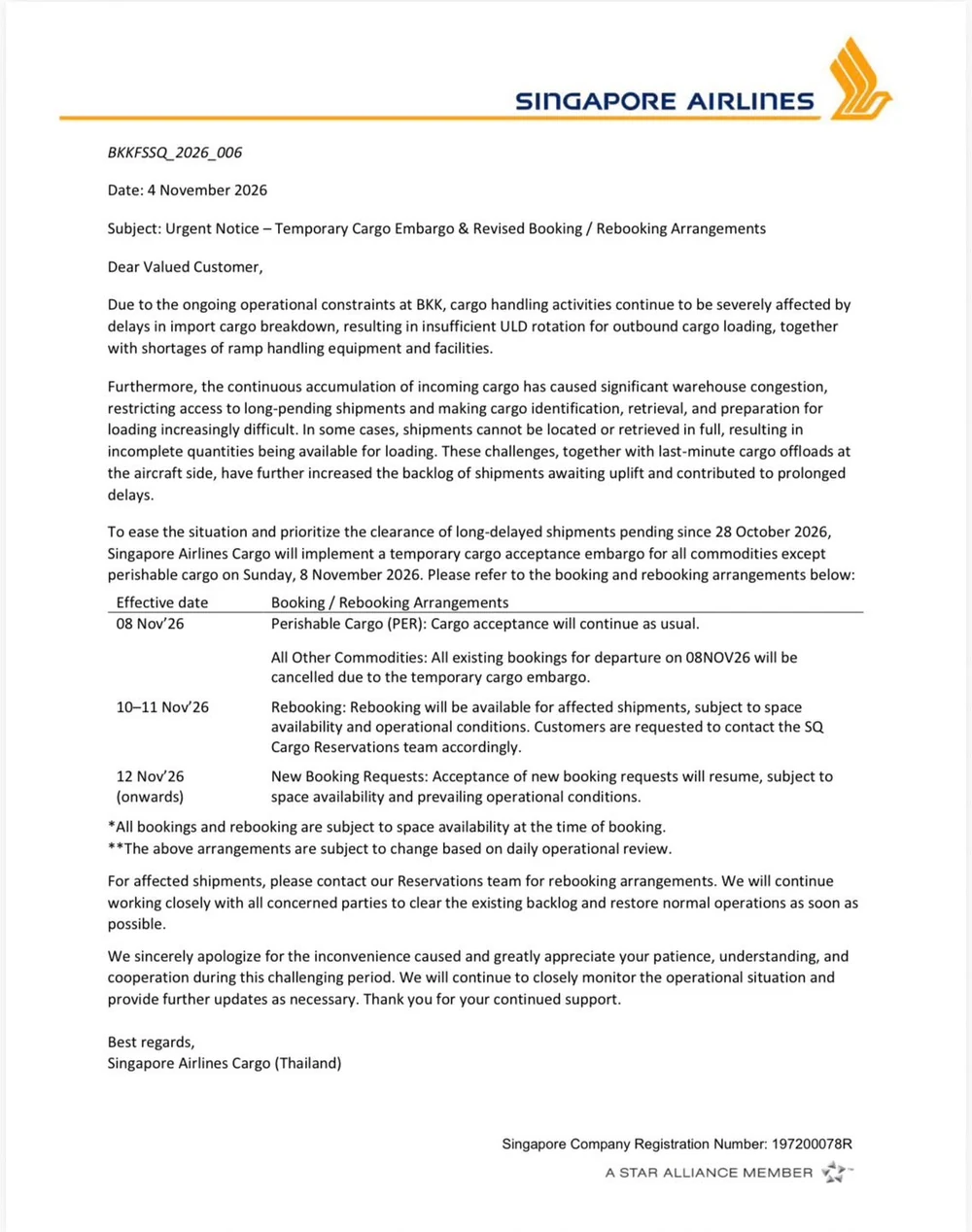
On 4 November, Singapore Airlines Cargo issued notice BKKFSSQ_2026_006 to customers in Thailand. It cited delays in import cargo breakdown leaving insufficient ULD rotation for outbound loading, shortages of ramp handling equipment, and warehouse congestion severe enough that in some cases shipments could not be located or retrieved in full, so only part of a consignment was available to load.
- 8 November. A temporary acceptance embargo on all commodities except perishables. Existing bookings for departure that day were cancelled.
- Perishables. Acceptance continued as usual throughout.
- 10 and 11 November. Rebooking available for affected shipments, subject to space, through SQ Cargo Reservations.
- 12 November onwards. New booking requests resume, subject to space and prevailing operational conditions.
The airline states that these arrangements are subject to change on daily operational review, so the resumption of new bookings should be confirmed rather than assumed. The stated purpose of the pause was to prioritise shipments that had been pending since 28 October.
What this means for cargo at BKK
The points below are our own operational read rather than anything the sources above state. Treat them as how we are planning around it, not as reported fact.
- A booking is not a confirmed uplift at the moment. Space released after an embargo goes to the backlog first, not to new freight.
- Perishables have kept moving on SQ throughout, which is worth knowing if your commodity qualifies.
- The constraint is ground handling rather than airline capacity. Switching carrier does not necessarily switch the problem, because the cargo still passes through the same terminals.
- Build extra days into cut-off planning, and confirm them shipment by shipment rather than working from the published schedule.
- For anything not genuinely time-critical, sea freight, or sea/air through another gateway, is worth pricing against the delay.
If you have cargo moving this week
Send us the route, the ready date, the weight and dimensions, and the commodity. We will tell you what is realistically available rather than quote a schedule that the ground situation will not support.
This situation has already changed more than once, and the arrangements above are the airline's own and may move again. We will update this page as the position changes rather than leave it standing. Our earlier report on the THAI Cargo embargo and its cancellation covers how the first disruption unfolded.